How many companies are there worldwide? How many have more than 250 employees? I would argue that you are as likely at guessing these numbers as you are at guessing how many skittles fit into a large glass jar. However, I am here to help… Or at least Statista can help both of us! According to Statista, there are an estimated 328 million companies registered worldwide. However, only around 350,000 have more than 250 employees1. It shocked me even more when I read that over 150,000 companies use Salesforce. A single company’s services are being used in nearly half of all medium-sized and large companies in the world; that is pretty impressive. Nevertheless, a lot of people still do not know what Salesforce is, where it comes from or what it does.
The End of Software
March 8, 1999: salesforce.com begins its journey, founded by Marc Benioff (Current CEO), Parker Harris (Current CTO), Frank Dominguez and Dave Moellenhoff. The initial idea was to create a CRM (Customer Relationship Management) software that was easy to maintain and update without dealing with complex software maintenance. Getting inspired by the simple, easy to understand design of amazon.com (with tabs across the top), Salesforce launched its first prototype within a month of development.
💡 Marc Benioff started his career as an intern developer for Apple, writing the example assembly language programs for the Macintosh 68000 Development System during the summer of 1984. He then joined Oracle at 21, became Rookie of the year at 22, and at 25 he became the company’s youngest VP.
Life in early 2000s is hard to imagine, at least for the younger generations (including myself) who believe the internet is an almighty god-like entity that has always existed and always will. Software has not always been so easy to use and install, while proving useful, the barriers to entry were incredibly high, costing millions of dollars for a small company to implement its own business applications. So how could a small software company stand out?
The brilliant marketing campaign, “The End of Software” did just that.
Salesforce knew that they could not compete with large corporations such as Siebel Systems, which already had rolled out Siebel CRM, by trying to make a better CRM system. Additionally, their product was nowhere as capable, but still, they needed a way to convince users that salesforce.com was better.
Marc Benioff does not want to convince tech experts, but rather C-level executives that have already spent millions of dollars on installing and deploying software; they are the decision-makers. If you are trying to get the attention of fed up C-level executives, hire a bunch of actors to riot in front of your competitor’s conference, and tell them that the end of software is here!
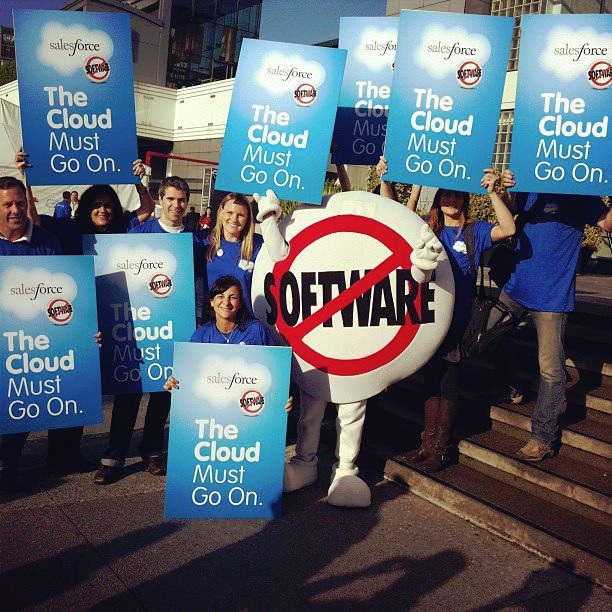
The idea behind the campaign is not to say that their CRM system is better, nor that their technology is the best in the market, but explain that all the pain and suffering of implementing conventional software will go away. With salesforce.com, businesses will only focus on business, and Salesforce will do the rest.
Salesforce has grown non-stop ever since, with a CAGR of 51.22% over the last 20 years2. Earning $5.43 million in 2001, and $21.25 billion in 2021.
Innovation at its finest
First of all, I want to focus on a very well-known term, not only in the software industry but worldwide, and that term is SaaS or Software as a Service. With SaaS, a company or individual can use a software without needing to download, buy a license, upgrade it constantly and renew the license every year. What SaaS providers offer is a simpler way to use software, which translates to paying a small fee every month, accessing the software through a link or app, and not having to worry about anything tech-related.
I am sure that most people reading this already knew or had heard of SaaS before, but I am also sure that 99% of readers did not know that the innovative company behind the concept of SaaS is… You are right, Salesforce! Anyways, innovating does not always mean to invent a new concept, or have a brand new idea, Salesforce is an innovator in many aspects, such as: developing the most advanced and useful CRM software in the world (even though it was not the first), implementing the 1-1-1 Model (1% of equity, 1% of employee time and 1% of its product is given back to the community), and finally, being one of the first company to popularize and fight for Cloud Computing. In brief terms, many concepts, technologies that we use nowadays and even donation schemes have been popularized or even pioneered by Salesforce.
So… What is Salesforce?
According to Salesforce, they are “a company that makes cloud-based software designed to help businesses find more prospects, close more deals, and wow customers with amazing service”. At first, it sounds comprehensible, but after some thought you still do not know what they sell or how they help companies close more deals and find more prospects. This is because, it is impossible to explain what Salesforce does in one short phrase.
Let me try with my limited knowledge, to explain what Salesforce is, and how it helps its clients!
Salesforce is a software company that offers digital CRM solutions to centralize and secure a company’s data. The most popular tools are Sales Cloud, Service Cloud and Marketing Cloud.
- Sales Cloud: Allows sales reps to keep track of Leads, Opportunities, Accounts and Contacts. Additionally, it enables them to visualize and track the evolution of the sale throughout its life-cycle. Furthermore, it facilitates managers to keep track of numbers through dynamic visualization and dashboards. Finally, it keeps contact information and engagement history within the company, rather than in the sales rep’s head.
- Service Cloud: Allows service centers to keep track of issues, increasing customer satisfaction. Moreover, it enables automation, helping a business scale their service through the automation of repetitive tasks. Finally, it helps customers find solutions to their problems through optimized self-service options, reducing the incident volume.
- Marketing Cloud: Empowers companies to engage more efficiently with its audience, allowing for one-to-one marketing. Furthermore, it allows businesses to keep track of engagement and loyalty of their clients. Finally, it empowers the digital platforms of a business, creating efficient processes and increasing conversions and ROI.
This is just an overview of Salesforce top services, but there is more… a lot more!
One of the core advantages of using Salesforce is its integration capabilities. All these Cloud services can be integrated with one another, providing a single source of truth to a business. Therefore, allowing sales reps to seamlessly communicate with their call centers and marketing team all at once, focusing on giving the best possible experience to the client.
On top of these services, let me list a few more of Salesforce’s products just so you get an idea:
- Salesforce Einstein: Empowers all of Salesforce services and products with a powerful generative AI model.
- Commerce Cloud: Empowers B2C and B2B commerce to automate, reduce costs, increase sales and build e-commerce platforms faster than ever.
- Data Cloud: Allows companies to unify their customer data to gain insights into their clients. Additionally, harnessing real-time data, automating workflows and enabling companies to connect between all of Salesforce’s Clouds in real-time.
- Tableau: The most powerful data visualization tool in the market. Create beautiful, dynamic and advanced visualizations with nearly any database in the world. Tableau is integrated into most of Salesforce’s solutions.
- MuleSoft: MuleSoft is the integration tool which allows for seamless connection between AI, Data and CRM. Additionally, empowering everyone to automate with either clicks or code.
- Slack: Most of you have heard of Slack, a chatting platform for companies’ employees. Yes, it is owned by Salesforce and it is amazingly simple to use.
- Salesforce Platform: My personal favorite! Allows developers to develop apps using low-code tools in record time. Use the Lightning Platform for a modern and personalized feel. Connect VS Code to your Salesforce Org, and develop anything you want. To start, try out a Playground Org and test out its capabilities. You can also implement new tools within your Cloud Solutions, adapting it to your needs.
- Net Zero Cloud: Use your data and create visualizations to go carbon-neutral faster.
- Small Business Solutions: A CRM solution that enables small businesses to increase efficiency and productivity at a smaller cost.
When a business puts everything together, it is able to get a complete view of each one of their customers, understanding their needs, minimizing the marketing efforts while getting even better results and keeping them happy because no more spam emails are needed to get their attention. At Salesforce, we call this Customer360, and it is the n.o 1 CRM platform in the world.
Hopefully this give you an overview of all that Salesforce is capable of doing. Nevertheless, I have one last surprise for you: This is not all!
I have tried my hardest to summarize every solution offered by Salesforce, because of it, I had to cut out on many of its advantages and capabilities. I believe that throughout the year, I will be able to learn and experience many of these solutions for myself, and I will be able to do a more detailed summary of all of these amazing tools. For now, I am still eager to learn more about it, and help companies in their digitalization journey with Salesforce.
Wait!!!! Do not leave yet, because I forgot the most important thing of all. Salesforce is focused on enabling everyone to use and develop new applications and tools within the Salesforce ecosystem and platform. How else would I have learned all this? Salesforce has developed a free web application in which everyone, no matter their background and knowledge, can learn everything about Salesforce: Trailhead.
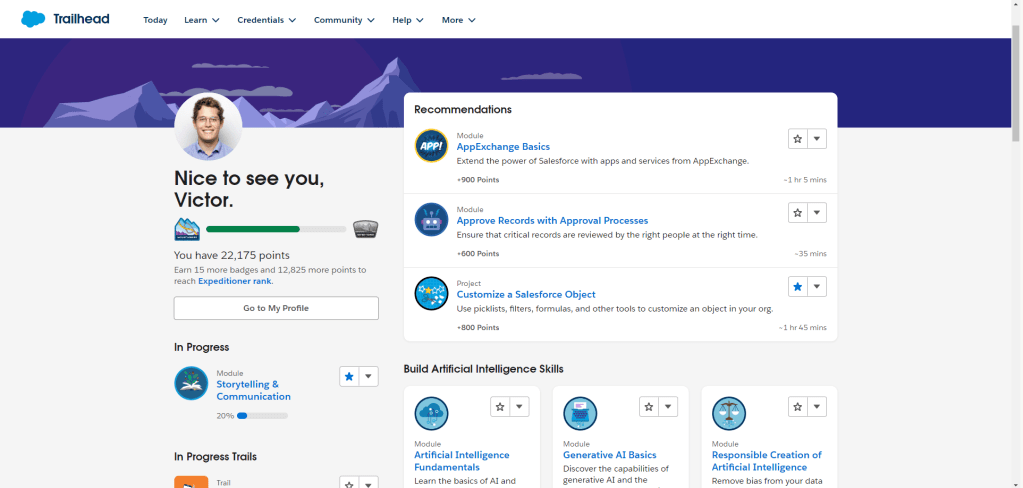
With Trailhead, you can do everything, from learning and testing concepts and tools within the Salesforce ecosystem, to getting official certifications such as the Admin or Business Analyst Certifications. These are recognized all throughout the Salesforce ecosystem, and can help anyone interested land a job within the Salesforce network of Partners or even at Salesforce.
Salesforce Ecosystem
The Salesforce Ecosystem is huge, it is expected to generate more than 9 million jobs and $1.6 trillion in new business revenue by 2026 according to IDC research3. However, this cannot be accomplished by Salesforce alone, as it has around 72,000 employees and has a revenue of around $21 billion. Salesforce impact comes from its Partners Program, as well as the employee engagement and satisfaction in the Salesforce Ecosystem.
The Salesforce Partner program formalizes a partnership between Salesforce and external companies. Partners play a crucial role in the Salesforce ecosystem by providing a range of services and solutions to help businesses implement, customize and optimize their Salesforce CRM systems. Examples of Salesforce Partners are: KPMG, Accenture, NTT Data and more.
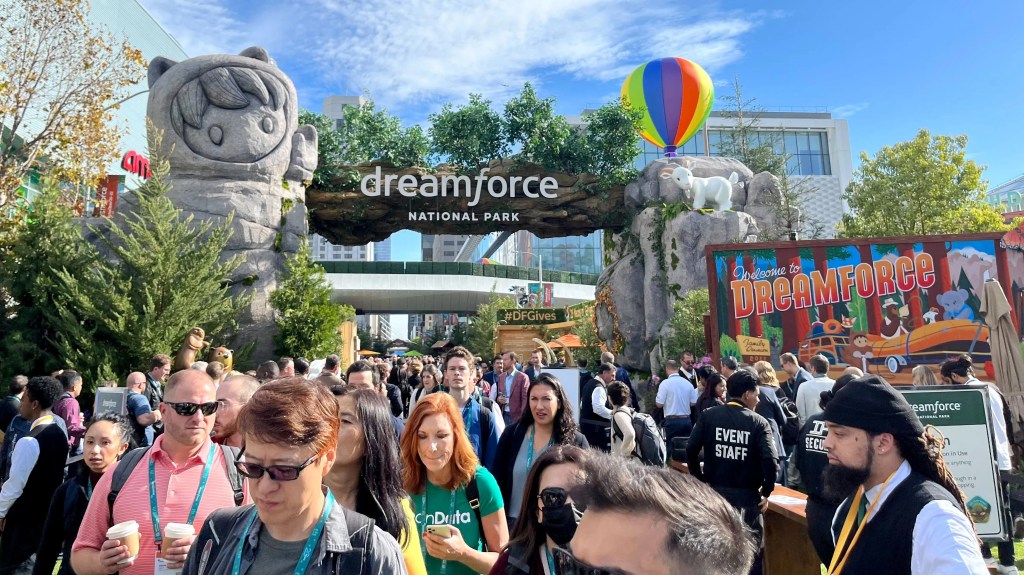
Additionally, the Salesforce ecosystem is made up of Trailblazers, which consist of individuals using the Trailhead app to learn and innovate within the Salesforce platform. There are many events around the world to meet fellow trailblazers and partners, all of which are made up of keynote speakers, fun events and concerts, and elaborate decorations to maintain the Salesforce theme and spirit all throughout. The biggest event is called Dreamforce, and it takes place once a year in San Francisco, where it all started. Dreamforce has had nearly 200,000 attendees, to the point where all hotels in San Francisco are filled up, and even a cruise ship had to be rented to accommodate all guests once before. This year’s Dreamforce is in two days, from the 12th to the 14th of September. I want to share some pictures of past Dreamforce events for you to have an idea of the size and look of the event.





Lastly, I am incredibly grateful to have been given a chance to learn and work within the Salesforce Ohana! My goal for the next year is to learn and experience new adventures, bring value to the company and look back to this short article with a complete new vision of what Salesforce is.
Bibliography
- Statista Research Department. “Large Global Companies 2021.” Statista, 7 June 2023, http://www.statista.com/statistics/1261035/large-global-companies/.
- Dean, Brian. “Salesforce 2023 Revenue and Market Share Statistics.” Backlinko, 21 Aug. 2023, backlinko.com/salesforce-stats.
- Grantz, John F, and Alan Webber. The Salesforce Economic Impact, IDC / Salesforce, http://www.salesforce.com/content/dam/web/en_sg/www/documents/pdf/2021-idc-salesforce-economy-global.pdf. Accessed 10 Sept. 2023.
 Victor Ovejero
Leave a comment